Tuesday, March 11, 2008

LinkedIn


The evolution of online Social Networks is of course fascinating to watch - there are moments of what pass for stability in the ecosystem followed by variation explosions in many different directions. The pace of the process is breathtaking - adaptions come and go almost as you watch. I am hoping there's a Political Science grad or Anthropologist out there who is tracking all this!

Let me just point at one item that has caught my attention. LinkedIn is dedicated (more or less) to business professionals. They actively discourage participants from creating large networks of people you don't know personally or strongly trust. You can ask a Question and look for a Job but there are no photo albums, favorites lists, widgets to "poke" or "zombify" your contacts (...this is NOT Facebook!)

After a certain standard amount of "bitching and moaning" from community members this (more or less) closed model has spawned a very active black market of derivative communities on Yahoo Groups and as independent websites.

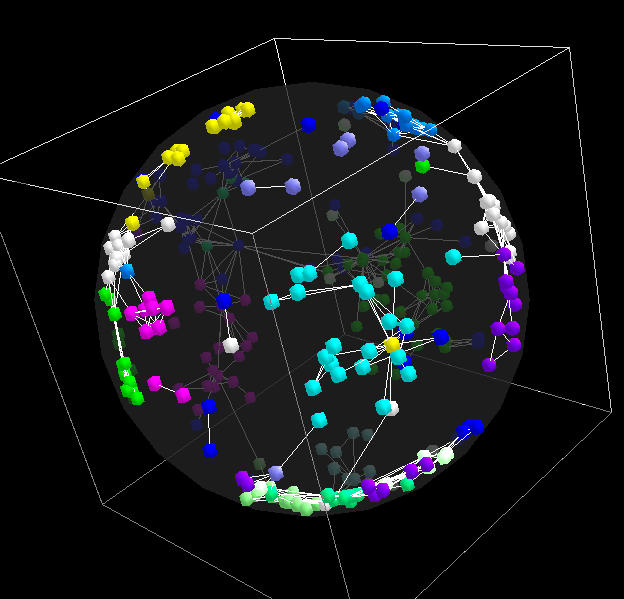
I made the top graphic from data I found on www.toplinked.com And you can join two of the groups I'm a member of - LinkedIn Power Forum or the Linking Northern California group. Feel free to invite me as a network contact on LinkedIn at any time! The top linked user on this social network has slightly more than 39,000 direct connections....eeeek!

Tuesday, February 19, 2008

Waiting for the World to change


I just noticed this over at Instant Messaging Planet:

"Digsby Merges IM, Social Networking and E-mail
This past week dotSyntax announced Digsby, an IM client that allows users to log into an existing AIM, MSN, Yahoo, ICQ, Google Talk or Jabber account and then merge everything into one buddy list. Duplicate contacts from different IM networks are merged, and Digsby also lets users send SMS messages from IM windows, change status, log conversations and more.

Users can also add their existing POP or Web-based mail accounts (such as Hotmail or Gmail) and receive notifications when new e-mail arrives. Users can add social network accounts, such as Facebook or MySpace and receive alerts for new friend requests, messages, group invites and other feeds. The application is currently in private beta and accepting beta tester applications at the Digsby Web site. "

I guess I'm struggling to come to grips with the underlying business model and who'all the client base will be over time. Don't get me wrong - I like Facebook, heck I even like LinkedIn, even with its Puritan mind set. But all these hyper-cross-pollinated IM services...?

On the other hand, networks that integrate rich semantically relevant results (FAST acquired by Microsoft) or networks that can be visualized (VisiblePath and Hoovers) seem like a move in the right strategic direction.

I wonder if any of this would work in the enterprise (inside joke!)?

Friday, February 15, 2008

Business Effectiveness of Video emails


On Tuesday I had an opportunity to meet with a client down in Visalia. As you may know Spring is in full swing here in California so I jumped at the chance. During the drive down I passed near the San Luis resevoir - it is just magnificent at this time!

But how can I most effectively communicate this to you? Clearly a well crafted narrative is one approach, perhaps with pictures, but better yet how about some video?!! I want to be able to reach out to you on every sensory channel. What it looked like, how it sounded, how the newly covered green hillsides smelled!

The same is true in Sales & Marketing communication. My goodness, how have we reached the point where I actually begin to appreciate the spam from a Kenyan banker because he included a picture of the chest of money he is attempting to get through customs! We send out tons of text-based blather and are elated if we get a 1% response.

One solution that is breaking new ground is here - video-embedded email. The raw technology to deliver this has been around for a while but it hasn't been offered as a well packaged service that I know of.

The guys at Point Marketing have done a nice job.

Wednesday, February 07, 2007

Selling into Early Markets with Precision Language


Had a lively discussion with Jonathan Bowder (Performance Partnership) in London today. One topic that got a bit brusied and bloodied was the use of Precision Language in the context of selling Complex Products into Early Markets.

Pretty clearly there's a revolution going on. For the first time there are now frameworks and tools that all salespeople can use to be infinitely more sophisticated in eliciting client needs, and optimally communicating a product's features and benefits. Any training in the use of these Precision Language skills will produce positive results both at the individual salesperon's level (they'll make more money), and for the parent company (more quality deals, shorter sales cycles).

From my perspective, the point of debate had to do with how Precision Language tools are actually used in real-world settings. The most notoriously difficult area for salespeople is penetrating early markets with technically complex products - the so called "market chasm" problem. Under these conditions Precision Language patterns are just one component in an arsenal of skills needed to be successful over the long term. In particular there's a deep need for a Messaging Architecture that supports the needs & value elicitation processes. As a trainer I feel we run the risk of sending our clients to a gun fight armed with a scalpel unless we coach them through language Patterns specific to their needs!

In fairness, this presents, in and of itself a much greater challenge when dealing with corporate clients... there's always a desire to find a quick, short term fix. Time will tell how these challenges are best addressed.


Reference: Geoffey Moore "Crossing the Chasm" (revised 1999)

Tuesday, January 30, 2007

Introduction to Neuro-Linguistic Programming (NLP), Part II


I like to practice Language Patterns every chance I get. Practicing on people I don't know is best - people you know are too easy. Strangers are "like a box of chocolates" you never know what you are going to get! Sometimes strangers can be pretty damned strange.

This morning I said "G'Day, you look great today"
I got "Why today?" "Didn't I look good yesterday!?" "... you have some nerve telling me I look good"

Sheesh! Mashed potatoes, gravy, and cranberry sauce!!!!

OK, So, after I'd stitched up the last of the claw marks on my butt I began to think... what just happened to me?

Here's the thing - selecting the correct words to construct an effective Language Pattern is just the beginning. Words carry the message but it also matters what kind of operating system is at the receiving end. Are you a PC trying to communicate with a Mac? Language Patterns also need to be wrapped in the protocol of the receiving party in order to be truly effective.

How exactly is this achieved? The good news is that humans can be divided, like Macs and PCs, into two broad categories. These are frequently referred to a Left-Brained and Right-Brained. The left brain deals with Logic, Language, and Analysis ... the right brain is a silent partner, and deals with holistic and creative insights. Left-brained behavior is characterized by a literal interpretation of the Physical world. A right-brained individual is driven by Emotional undercurrents that may not be immediately apparent.

Clearly I'd make the mistake of wrapping my Language Pattern in a left-brain protocol but handed to a right-brained receiver. Lesson learned, as they say.

Significantly, although right-brained people relish metaphors, analogies and secret meanings, they are identified by their blunt and direct style of speech. The reverse is true for left-brained people. They prefer direct literal language, but habitually communicate in dreaming, rambling speech.

Watch, and listen to, the couples you know. Almost invariably, you will see a Physical communicator associated with an Emotional communicator. They find each other irresistible....!

Monday, January 22, 2007

Introduction to NLP, Neuro-Linguistic Programming


I have posted a pdf version of a short presentation I recently gave -
Introduction to NLP (Neuro-Linguistic Programming)

I hope you enjoy it - and by all means send feedback.

Friday, January 19, 2007

Hook, Line, and Sinker


So ya wanna be popular on the Web, eh, punk?!

A great post from Todd Malicoat "The LinkBaiting Playbook" over at webpronews

Wednesday, January 17, 2007

Social Networks that REALLY Work


This just in from The Guardian... and yes, I have applied for the Director's position

NLP, Neuro-Linguistic Programming, the flip side of SNA?


SNA is primarily about discovering the relationships between people. The intriguing (obvious) question is WHY certain members of a group become hubs and WHAT personality/behavior characteristics they exhibit in common with other hubs. Not surprisingly I'm not the first to ask this question! (doh!)

Unlike digital networks ("a series of tubes") which process information in a hierarchical and rigidly predictable way, humans communicate using idiosyncratic rules. As a rough guide only about 20 percent of the communications we produce are under our conscious control. Eighty percent is guided and shaped unconsciously. We blush, guffaw, stammer, fidget, look into the distance, as we select terms and expressions based on our unique history and the impact we hope to produce in those we are communicating with. Similarly, 80% of the messages we receive are unconsciously filtered, generalized, and distorted.

Clearly, great communicators have some heightened ability to understand others and be understood by them in turn.

Since at least the 50's (Noam Chomsky) and many others have attempted to understand the sources, structure, and use of language. In the broadest sense these original insights have been absorbed into the NLP movement, and if you can get through the humbo-jumbo it's worth the effort.

Wednesday, November 08, 2006

Growing a Social Network


There's currently so much hyper-ventilation surrounding "social software" and Web 2.0 that it's easy to lose sight of the underlying humanity. I may as well say it clearly: social sites extend and accelerate our ability to participate in a greater number of communities than we would have otherwise experienced but they don't fundamentally change how we should treat each other. The suggestion that an online ID is a license to behave badly and without consequences is neither a recipe for inner peace nor social success.

Treating people properly, ala Dale Carnegie's How to win Friends and Influence People (no matter how badly they may behave) counts for a lot.

So, what actually steps can you use to strengthen and grow a social network? Here is a short check list -
Gather people into your network that have a shared interest, history, objective. One of my favorites is 11 Friends in Germany.
Born out of the friendship of two crazed soccer fans who met on the grandstand of the Bielefeld stadium, it's no surprise 11 Freunde (11 Friends) reads more like a love letter than a typical sports magazine.

Don't just sit there - make a contribution. Take a chance, ask a question, leave a comment, add a post - this is the fertilizer in your network garden.
Now do it again, apply some care and feeding to your network - this is where a watering can comes in handy! Keep in regular touch with group members(it takes more than a Christmas letter).
Actively connect others within your network, after all that's what this is all about! Hey, now that you have a new suite of social skills don't assume that everyone has achieved the same level of enlightenment! Be an enabler, make introductions, you'll be surprised how well your network responds.
Ask for feedack, solicit help. I clearly remember the first time I left a comment on a website - just a "thank you" for creating the resource. I was astonished to get a personal response from the webmaster saying how much they appreciated my note and how rare it was to have visitors acknowledge their work.

So, there it is. A few obvious ideas to make the planet a little better. Finally it goes without saying that these comments DO NOT cover Nigerian Banking offers, "lucky" chain letters, sure thing penny stocks etc.; for these I hope there's a very special corner in hell.

Monday, November 06, 2006

Genographic


You are reading this on a computer monitor but it is a little like a message in a bottle. We are connected to each other only in the sense that I threw this note into a virtual tide for anyone to read and you have been kind enough to open it. Were we ever to meet we would both ask - where do you come from, how did you get here, and always, what do you look like? (you KNOW it, the differences are the spice!)

Yet we are already connected. Long ago we had the same parents, uncles and aunts - in many ways it was not that long ago at all! Within each of us, within every cell, there's a little marker that tells who you are, where you come from.

IBM and National Geographic have teamed to gather sufficient information over a five year project to map out the migration details of our ancestors as they explored every corner of the Earth. You can contribute your DNA to this project if you wish.

Links

Genographic
IBM DB2

Sunday, November 05, 2006

Hoovers Connect - Business to Business Social Networks


Hoovers and Visible Path have just released a beta version of Hoovers Connect. This joint effort extends the current trend of attempting to monetize SNA by using it primarily for Sales enablement. It will be very interesting to see how this turns out. The barriers to success seem fairly formidable - on the one hand it is necessary to install software that monitors email traffic patterns (from/to, not content); on the other hand network participants are expected to accept communications from "trusted" third parties... and you can expect a majority of these to be sales related. Just what the doctor ordered - more sales calls!?

To be fair, I am a strong advocate for Referral Based Selling. Both in theory and practice the number one rule of sales is "people don't buy from people they don't trust!" so that building a network of trusted contacts can make the difference between being just OK, and being great. Whether this can be achieved through mining email contacts is an open question.

Ideally I'd love to see more of Web 2.0's core ideas incorporated into these models, particularly with respect to user-generated and mediated content. I believe there would be a much greater level of participation in these networks if the outbound communication was framed as a request for help - "help us create a product that will meet your most demanding needs" - rather than "I know you through Ferris when can we meet?"

Reference Links
Hoovers
Hoovers Connect Beta
TechNewsWorld
Visible Path

Thursday, October 26, 2006

Visualizing Enron's Social Networks


Charles Armstrong and his team over at Trampoline Systems have released an online interactive demo of their capabilities.

In October 2003 the US Federal Energy Regulatory Commission placed 200,000 of Enron's internal emails from 1999-2002 into the public domain as part of its ongoing investigations. The archive offers an extraordinary window into the lives and preoccupations of Enron's top executives during a turbulent period. Trampoline engineers used this data as testbed during development of the company's SONAR technology. The result was so fascinating we decided to open it up and allow anyone to dig in. The Enron Explorer lets you investigate the actions and reactions of Enron's senior management team as the noose began to tighten.


You can jump directly to the demo page here I highly recommend reading the Comments section in this area of the site.

Trampoline also got a shout-out from Wired Magazine earlier this year.

Trampoline is headquartered in Shoreditch, London. What is a "shoreditch" anyway? Out here we have Los Altos (the Heights) and Milpitas (the Cornfield); at least they sound more attractive!

Wednesday, October 18, 2006

Sunni and Shia - a map tells it all


There's an astonishing article by Jeff Stein today "Can you tell a Sunni from a Shiite?" (New York Times; free registration required). It's astonishing because he asked a wide selection of Washington D.C. policy-gods if they could give him a brief explanation of the differences between Muslim Shia and Sunni's; few could! Without getting into a lots of details one might hope they would at least know that most Muslims (85%) are Sunni while the remainder are Shia. More importantly, vis-a-vis, the current problems in Iraq, Iran is mostly Shia. The map tells it all. Particularly notice the concentration of Shia in Iraq. This map was produced, and made available online, by the Central Intelligence Agency!
If you think this is interesting you might begin to consider the historical differences between Iran (Persia) and the Arab world. It is not even remotely true to say that all Muslims have a shared hatred of the West.
One reference "Sons of the Conquerors" Hugh Pope takes a look at the changing landscape of the old Ottoman Empire, state by state.
Now if I could find some way to get the policy-gods away from their comic books and on to some serious reading I'd be a happy man.

Jan 2007, more Christian Science Monitor here

Thursday, October 12, 2006

Social Network Analysis - Executives using them now...?!


A compendium of SNA articles from BusinessWeek here In general it looks like there's beginning to be a modest awareness of how social software can be used in the context of the enterprise - so, better than a poke in the eye with a sharp stick! Still, I feel we have a lot of work to do articulating the impact of SNA/ONA on productivity, organizational agility, and customer satisfaction.
While we are on the subject of social networks in business settings - you should (must) be a member of the LinedIn network.

Global Social Networks


[Personal Note: I've been in Yosemite... no cell coverage, no WiFi...spooky!]
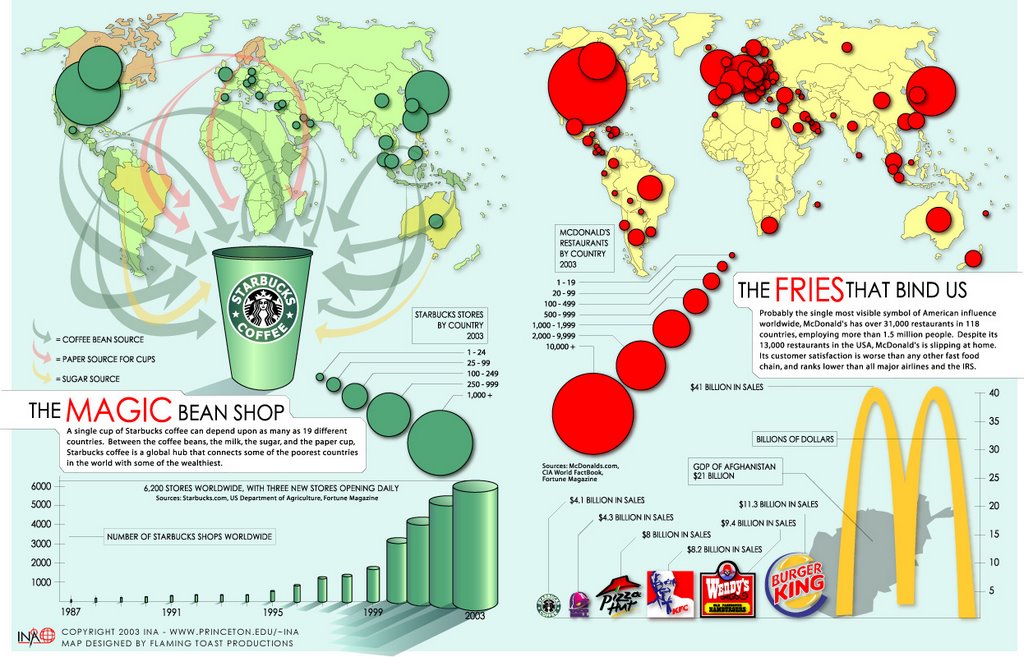
Social networks are wonderful, and instructive, and infuriating all the same time mainly because the volume of information needed to make sense of them is large and everchanging. When faced with this type of problem we correctly ask - show me the big trends, how big is this network, what direction is it going, how quickly does it change...etc? Basically, give me some signposts to follow! Visualization condenses masses of data into meaningful images that provide these key signposts.
The image above comes from the International Networks Archive at Princeton - and there's more to see here
Obviously these particular maps took time and careful study to produce but I believe they are pointing us in the right direction. We are only at the very beginning of visualizing social networks.
What are the best social networks maps YOU have seen?

Wednesday, August 16, 2006

Social Networks and Space Planning - How Buildings Learn


Seth Earley pointed me towards a book my Stewart Brand “How Buildings Learn” – it’s fair to say that I’ve been consumed by it for the last few weeks – members of my family avoid making eye-contact with the whispered prayer – “Please God don’t let him start up about buildings & time!”

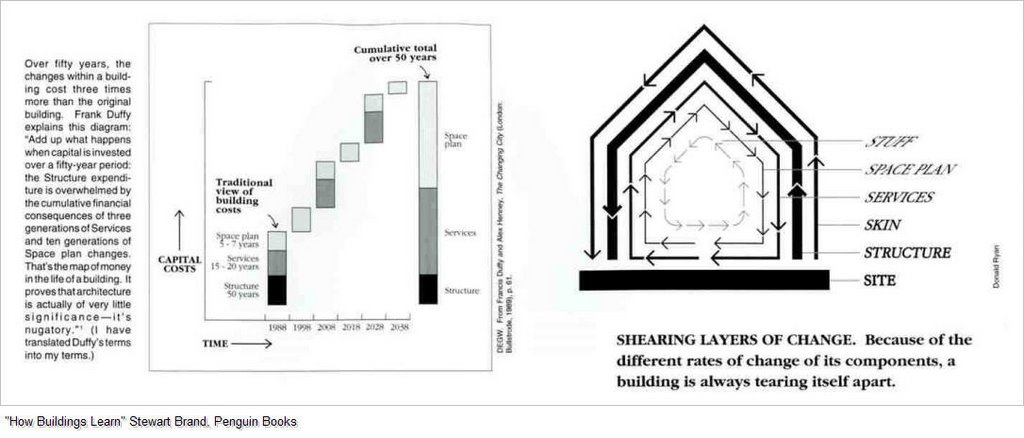
The book is full of surprises but perhaps its most intriguing central idea describes the interaction between buildings and their occupants through time. It seems too obvious to state that we change buildings but in many and varied ways buildings also change how we go about our activities. Brand provides a model for the various layers of interactions and excahnges between buildings and their occupants. He makes the point that these layers can be divided into two broad categories characterized by the timeframes in which they play out. On one hand there are aspects of a building, such as its site and foundation, that change only slowly or not at all; on the other hand there are the fast-changing furnishings, draperies, and wall coverings that are expected to change relatively frequently. A critical insight – the slow-changing features of a design constrain the fast-changing elements.

Brand offers example after rich example of how this plays out in practice and opens a window onto some very juicy questions. Specifically, given that internal “spaces” will be modified to meet evolving needs, and given that via social networks analysis we are beginning to undersatnd how people and organizations interact in detail, what is the best space planning strategy to achieve better collaboration, organizational agility, creativity, productivity etc.?

My initial searches for answers to these questions has come-up short. There are quite a few resources that describe the advantages of modularized space and furniture designs. However, the main measurable advantages seem invariably related to the lowered (facilities) costs associated with reconfiguring work spaces as individual jobs and organizational responsibilities change. Exactly how work spaces should be designed to meet defined organizational challenges seems to be open to a good deal of conjecture and anecdotal commentary (e.g. communal spaces are valuable for collaboration, window-views to the outside are good for morale…with little or no evidence).
Free Image Hosting at allyoucanupload.com

It is interesting to make some guesses about the future of space planning in the context of mappable social networks. Functional responsibilities within organizations can be divided into two broad categories – PROCESS and, CONTROL. The basic idea is the Process groups perform well defined tasks within a specific area while Control groups regulate activites/communication over multiple functions - with lots of opportunity for ambiguity and confusion!


Even though it may not be possible to predict exactly the future relationship between social networks and space planning it is possible to know what roadsigns to look for –

  1. Link Processes and Control - that is, physically arrange organizations so that members of a Control group are close to where the Processes they are responsible for are located. There are many examples where this happens already - Finance and HR will often have personnel imbedded in departmental offices. But, how often does Marketing, Regulatory Compliance interface directly with Production, R&D...

  2. Systematic Reviews – Organizations conduct periodic Communication reviews the same way we hold Design and Performance reviews today.

  3. Connect Virtual and Real – Establish non-virtual connections between centralized and remote employees. Are there desks reserved for field employees so they aren’t just visitors at the corporate office?

  4. Competitive Communication – Is there one person within a department that is responsible for communicating and updating the competitive status of the group? How are we doing against our group goals? Where are we not getting the tools and information we need?

Your turn…

Monday, June 26, 2006

Top Ten Social Networking Sites (April 2006)


Two interconnected views of the world -

By volume and year-over-year growth, here

By stock price/gains, here

Quepasa (QPSA) is a latino-oriented version of MySpace, The Knot (KNOT) is a bridal/wedding planning site, WebMD (WBMD) is well...WebMD. Clearly a central message in these numbers is - if you want satisfied users, have the technology fit the need, not the other way round (as is all too often the case)

It's also worth taking note of the fact that there are some 2 billion teenagers in the world - that's 500 times the number of teenagers at the peak of the baby boom! Moreover, most of these teenagers are in Asia, South America and, to some degree Africa. If you are developing "english-only" sites or applications you need to get you head examined.

Saturday, June 24, 2006

Sweet Holy Moses - Kawasaki interview with Gasperini


The Bay Area is generally so full of overeager VC posers and one-shot-wonder doofuses that you develop a type of blindness to it after a while. But since I'm very concerned that the "bad" money surrounding MySpace, Facebook et al. will drive out whatever crumbs of "good" money there are for sane SNA projects, I try to stay in touch with the latest opinion drivers. When I clicked through to this interview posted on Guy Kawasaki's blog my finely tuned BS-o-matic immediately redlined - although in all fairness it is well worth a look; read both the body of the interview and the posted comments. In a nutshell Gasperini gives an overview of her analysis of "youth culture"...

And since it is Friday night, make sure to click through to MySpace the Movie...mentioned in the article.

Friday, June 16, 2006

Scale-free Networks


When I recommended a few books related to social networks recently Dan Keldsen of the Delphi Consulting Group suggested that I include two additional titles – “Linked” by Albert-Laszlo Barabasi, and “Six Degrees” by Duncan Watts. Barabasi maintains a website with candid photographs of many of the great researchers in this space. Dan also pointed me towards some podcasts that he’s made available on his blog – paricularly a dialogue with Konstantin Guericke from LinkedIn – now three years old and probably one of the only pure-play social websites to actually turn a profit.

Although Barabasi and Watts are skilled numerical scientists there is an interesting lack of any mathematics in both texts – probably due to their publishers not wanting to frighten away too many potential readers! Math here